


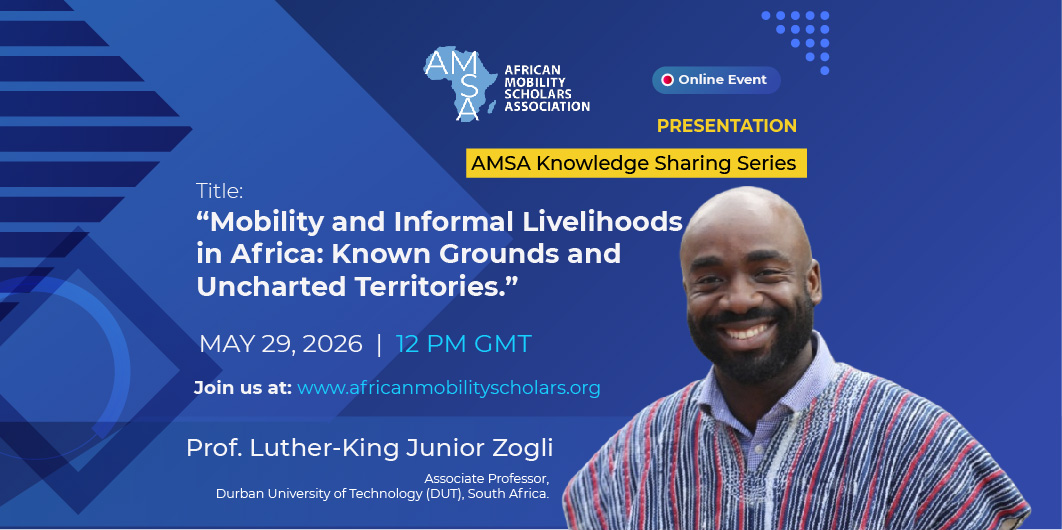
Mobility and Informal Livelihoods in Africa: Known Grounds and Uncharted Territories.
A Presentation by Prof. Luther-King Junior Zogli
Mobility and informal livelihoods are defining features of African economic life. Yet, a decade of scholarship on their intersection has produced more volume than insight, covering familiar ground repeatedly while leaving vast terrain unexplored. This systematic review synthesises evidence from 84 empirical studies published between 2015 and 2026 in Africa, asking not only what research has found but what it has consistently failed to look for. Following PRISMA 2020 guidelines, 529 records were screened emanating from 18 African countries. What the literature has covered, it has covered well. Cross-border trade, rural-urban migration and forced displacement have been well documented as the main routes through which mobile populations come to depend on informal economies for survival. Women are central economic actors, social networks enable both movement and enterprise, and policy frameworks across the continent persistently criminalise informality rather than support it. The uncharted territories are more revealing. Southern Africa, particularly South Africa, dominates the evidence base while Francophone Africa, Central Africa, platform-based informal work, climate-induced mobility and longitudinal livelihood trajectories remain substantially understudied. Theoretically, the field continues recycling frameworks that were not built with African realities in mind. This review advances a forward-looking agenda for African mobility scholarship, one that redirects attention towards neglected regions, populations and methods, and towards building theoretical tools grounded in African experience.
Key Words: Mobility; informal livelihoods; Cross-border trade; Migrant entrepreneurship; Gender; Forced displacement
L. J. Zogli; E. Lawa; H.S. Shange
Department of Applied Management, Faculty of Management Sciences
Durban University of Technology, Durban, South Africa
Organizer

Prof. Luther-King Junior Zogli is an Associate Professor at the Durban University of Technology (DUT), South Africa. His research sits at the intersection of entrepreneurship, small business development and informal economies, with a particular focus on youth economic participation in African contexts. Supported by South Africa’s National Research Foundation (NRF) and the Department of Higher Education and Training (DHET), his funded work examines how young people develop entrepreneurial pathways within formal and informal economic spaces in South Africa. His broader research has followed informal workers and small business owners across urban Ghana and South Africa, where mobility consistently shapes how people access opportunities and build livelihoods.
His work has appeared in Scientific African, the Southern African Journal of Entrepreneurship and Small Business Management, and Progressio, among other outlets. He serves as a reviewer for the International Journal of Urban Sustainable Development and Cogent Business and Management, and is a member of the Economic Society of South Africa.
Beyond his research, Prof. Zogli has supervised over a dozen Masters and PhD graduates across the continent and played a leading role in curriculum design and programme coordination at DUT. He has also reviewed qualifications for higher education institutions across South Africa and the SADC region.
He holds that the informal economy is not the margins of African development. It is the center.