
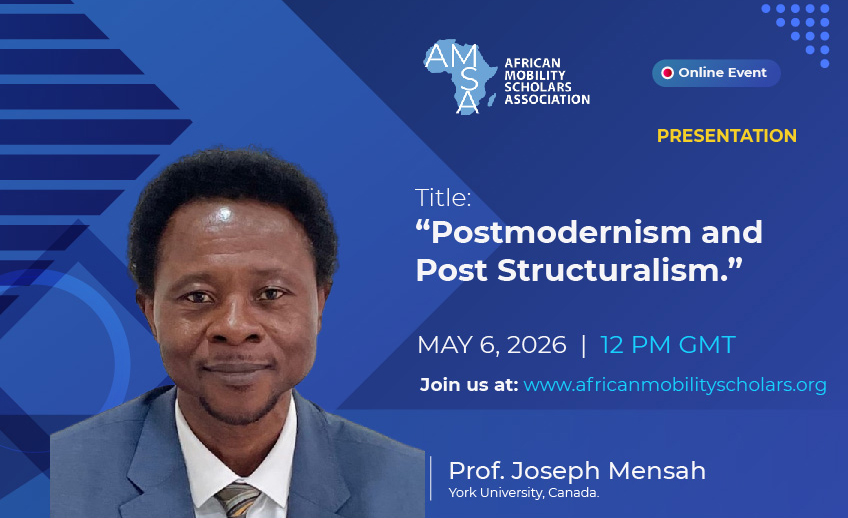
Professor Joseph Mensah delivered a comprehensive presentation on postmodernism and post-structuralism, covering key thinkers including Jacques Derrida, Michel Foucault, Jean-Francois Lyotard, and Jean Baudrillard. He explained postmodernism’s rejection of grand narratives, binary oppositions, and stable structures, emphasizing how these concepts challenge traditional Western thought and support diverse perspectives including racial minorities, women’s rights, and LGBTQ movements. The presentation included detailed discussions of Derrida’s deconstruction theory, Foucault’s power-knowledge framework and biopolitics, and Baudrillard’s simulation theory, with examples from art, architecture, and current events. During the Q&A session, participants asked questions about the implications of postmodernism for African contexts, human agency versus structural constraints, and the relationship between postmodern theory and multilateralism in global affairs.
Postmodernism and Post-Structuralism Overview.
Prof. Mensah presented an overview of postmodernism and post-structuralism, explaining their key tenets and major thinkers. He distinguished between post-structuralism and postmodernism, noting that while they are often used interchangeably, post-structuralism emerged as a reaction to structuralism and later evolved into postmodernism. Prof. Mensah outlined the main arguments of post-structuralism, including the subjectivity of knowledge, the instability of structures, and the importance of diversity and difference. He explained key concepts like deconstruction, binary oppositions, and logocentrism, using examples from language, art, and architecture to illustrate these ideas. Prof. Mensah also discussed the work of influential thinkers such as Jacques Derrida, Michel Foucault, and others, highlighting their contributions to the development of postmodern thought.
Deconstruction and Foucault’s Methods.
Prof. Mensah explained the deconstruction method developed by Jacques Derrida, which involves breaking down conceptual structures by examining binary opposites and their hierarchical relationships. He provided examples of Derrida’s deconstructive techniques, including his critique of Socrates’ views on writing versus speech and his analysis of the Declaration of Independence’s claim of self-evident truth. The discussion then shifted to Michel Foucault, focusing on his work examining the interconnection between power and knowledge, with Prof. Mensah explaining Foucault’s method of archaeology and genealogy rather than traditional history, and his concept of biopower.
Panopticon and Biopower Concepts.
Prof. Mensah explained the concept of the Panopticon, a prison design created by Jeremy Bentham where a central watchtower allows for constant surveillance without prisoners knowing when they are being observed. He described how Michel Foucault expanded on this idea to distinguish between traditional repressive power and modern biopower, which operates at a population level through statistics and administrative measures rather than targeting individuals directly. Joseph also touched on Foucault’s concept of power being everywhere in relationships and how it can be productive rather than just repressive, concluding with a mention of Foucault’s view that humans as a concept are a recent invention nearing extinction.
Postmodernism and Social Constructivism.
Prof. Mensah discussed the concepts of man as a recent creation and the development of social labels, referencing Foucault’s work on archaeology and genealogy. He explained how Foucault’s methods dig into deep structures and historical connections rather than relying on traditional linear history. Prof. Mensah also covered Jean-Francois Lyotard’s definition of postmodernism as “incredulity towards metanarratives,” explaining how postmodernism is skeptical of grand theories and embraces fragmentation and localization over unity. The discussion touched on how grand narratives can create “othering” and impose uniformity, with references to concepts from Wittgenstein regarding language games.
Baudrillard’s Orders of Simulation.
Prof. Mensah discussed the concept of simulation as explained by philosopher Jean Baudrillard, outlining four orders of simulation. He described how society has evolved from copying reality (first order) to creating copies that mask reality (second order) to signs replacing reality entirely (third order), culminating in a world of hyper-reality where the original no longer exists. Prof. Mensah used the Gulf War as an example to illustrate Baudrillard’s argument that modern conflicts are increasingly simulated events rather than genuine battles between opposing forces.
Postmodern Philosophy Discussion Overview.
Prof. Mensah discussed postmodern thinking and key philosophers, focusing on concepts like simulation, meta-narratives, and the challenges of trust in postmodern philosophy. He explained Baudrillard’s ideas about simulation and reality, as well as the work of Derrida, Foucault, and other influential thinkers. Prof. Mensah highlighted the impact of postmodern thought on academic writing, social resistance movements, and contemporary issues like surveillance and democracy, while cautioning about the potential limits of postmodern provocations.
Postmodernism’s Impact on African Narratives.
The Q&A session focused on Prof. Mensah’s presentation about postmodernism and its implications for Africa. Dr. Todd Ross asked about the dual impact of postmodernism, where it empowers African narratives while potentially distorting them further. Prof Mensah responded that while postmodern philosophy helps legitimate African perspectives, there are concerns about fake information spreading through digital platforms, emphasizing the need for critical thinking and background research. Delali raised questions about human agency’s interaction with structures and the concept of imminent critique, which Prof Mensah explained as a deconstruction technique by Derrida for examining how texts use and depend on each other.
Postmodernism and Migration Discourse.
The meeting focused on a discussion about postmodernism and post-structuralism, led by Prof. Mensah. Charles raised questions about how these concepts relate to multilateralism and common understanding in the modern world, particularly regarding topics like human rights and migration. Joseph explained that postmodernism highlights the multiplicity of meanings behind words, emphasizing the need for careful definition and consideration of cultural contexts when negotiating important issues. The discussion also touched on the role of power dynamics in conflicts, with examples like the U.S.-Iran negotiations and the Palestinian conflict. Kwesi asked about applying Foucault’s concepts to protracted forced displacement, and Joseph explained how power asymmetries play a significant role in such situations. The conversation ended with a question about how post-structuralism can help question the power behind labels used in migration research, to which Joseph suggested that redefining terms to be more meaningful and rights-oriented could help address the complexities in migration discourse.